Direct answer
Bath salts do not "expire" in the same way that food does, but the finished product can lose quality and, depending on its formulation and storage, eventually become unsuitable for use. Mineral salts such as magnesium sulfate are chemically stable, while fragrance or essential-oil components can oxidize and moisture can change the physical and microbiological stability of the finished product.
The important distinction is between the mineral ingredient and the complete bath-salt formulation.
Do the mineral salts themselves expire?
Pure mineral salts such as Epsom salt (magnesium sulfate) are not perishable materials in the way food is. The compound itself does not suddenly become ineffective because a calendar date has passed.
That does not, however, mean that every bath-salt product has an unlimited shelf life.
A commercial bath salt is usually more than magnesium sulfate. It may contain other salts, fragrances or essential oils, botanicals, starches, clays, or other functional ingredients. The stability of the finished product depends on all of those components, as well as its packaging and storage conditions.
That distinction matters.
A five-year-old bag of dry magnesium sulfate is one question.
A five-year-old finished cosmetic containing fragrance, botanical material and other ingredients that has been repeatedly opened in a humid bathroom is another.
What actually changes as bath salts age?
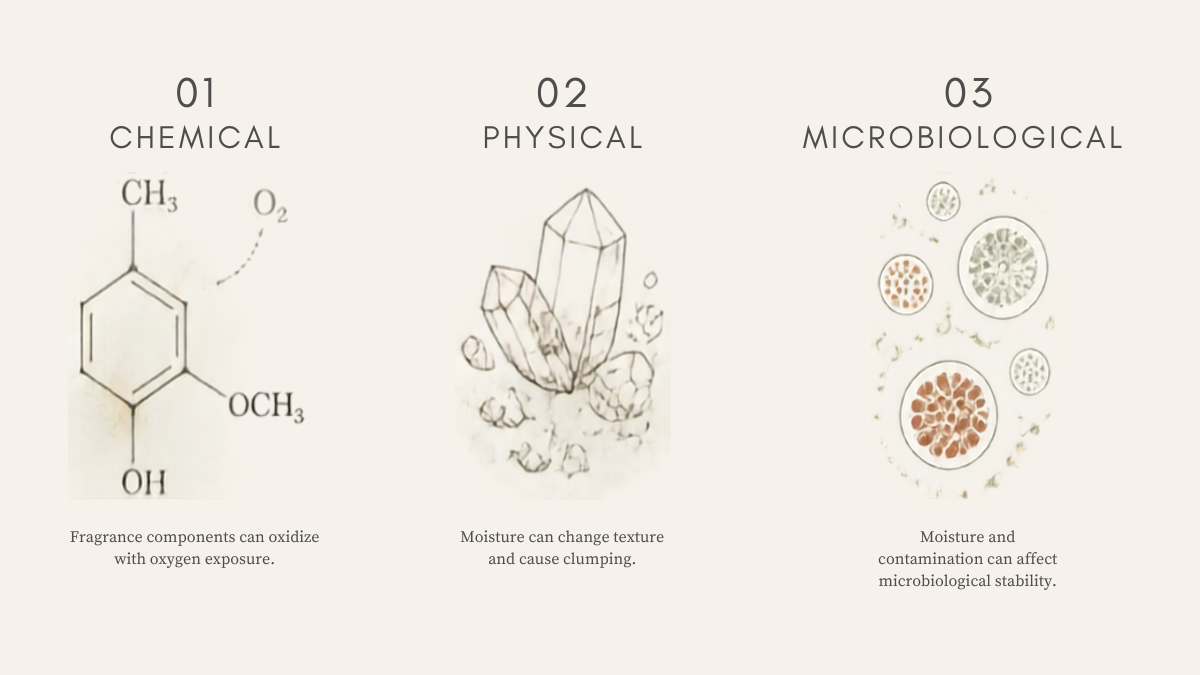
There are three different things to consider:
- Chemical stability — do the ingredients change chemically?
- Physical stability — does the product clump, change colour or texture?
- Microbiological quality — has moisture or contamination created conditions in which microorganisms can grow?
These do not necessarily happen at the same time.
1. Fragrance and essential oils can oxidize
Essential oils and fragrance materials are mixtures of organic compounds. Some components can react with oxygen over time, particularly when exposed to air, heat and light.
Linalool is one example. It is a common fragrance terpene found in many scented products. Research has shown that linalool undergoes oxidation in air and forms oxidation products that can have greater sensitizing potential than the original material.
This is an important point for scented bath products.
However, there is a difference between saying:
"Linalool can oxidize."
and saying:
"This bath salt expires after 12–18 months."
The first is supported by evidence.
The second requires evidence about the actual finished formulation.
We therefore should not assign a universal shelf-life number to a bath salt simply because one of its fragrance components can oxidize.
2. Moisture can change the physical product
Bath salts are hygroscopic to varying degrees, meaning some salt ingredients can absorb moisture from the surrounding environment.
This can cause clumping.
Clumping by itself does not automatically mean that the mineral salt has chemically "expired." It is primarily evidence that the product has been exposed to moisture.
But moisture matters for another reason: it can affect the stability and contamination risk of the finished cosmetic product.
FDA notes that moisture, heat, air and storage conditions can contribute to deterioration of cosmetic products and that improperly stored cosmetics can deteriorate before an expected shelf life.
So:
Clumping ≠ automatically expired.
But:
Moisture exposure = something worth taking seriously.
3. The finished formulation is what ultimately matters
This is the part that is often missed when discussing bath-salt expiration.
A manufacturer does not establish the shelf life of a product simply by asking how long magnesium sulfate remains chemically stable.
Shelf life generally means the period during which the product is expected to remain safe and continue to perform as intended under specified storage conditions.
That means the relevant question is not:
"Does Epsom salt expire?"
It is:
"How long does this particular finished bath-salt formulation remain within its intended quality and safety specifications?"
That depends on the formulation, packaging, manufacturing process and storage conditions.
Can old bath salts become unsafe?
They can become unsuitable for use, but we should be careful about making a simple "expired = dangerous" claim.
A dry, well-sealed mineral product is very different from a product that has been repeatedly exposed to water, wet hands, steam or contamination.
FDA specifically notes that cosmetics can deteriorate because of improper storage and that products exposed to excessive heat or moisture may deteriorate before their expected shelf life.
For that reason, an old bath salt should not be judged solely by its age.
Consider:
- Has the package remained properly sealed?
- Has water entered the product?
- Has the smell changed substantially?
- Has the colour changed?
- Is there visible foreign material or mould?
- Has the product been stored in excessive heat or humidity?
- Is it past the manufacturer's stated best-before/use-by period?
If there is visible mould, unexpected foreign material, significant deterioration or an unusual smell, the sensible choice is to discard it rather than trying to rescue it.
What about a weaker or different smell?
A change in fragrance can be a useful warning sign, but smell is not a complete safety test.
Essential-oil and fragrance components can oxidize over time, and oxidation can change the odour profile. Oxidized linalool has also been associated with allergic contact reactions in sensitized individuals.
But the reverse is not necessarily true:
A product that smells normal has not been proven safe simply because it smells normal.
Sensory inspection is one useful quality check. It is not a substitute for proper product stability and safety testing.
How should you store bath salts?
Good storage reduces unnecessary deterioration.
Keep the product dry
Do not introduce water into the pouch or jar.
Use a completely dry scoop or spoon, and close the package promptly after use.
Keep it away from excessive heat
Avoid storing bath salts beside a geyser, radiator, in direct sunlight, or in a hot vehicle.
Heat can accelerate chemical deterioration and can contribute to changes in cosmetic products.
Reduce unnecessary air and moisture exposure
A properly closed package provides better protection than an open pouch sitting in a humid bathroom.
For occasional users, keeping the original package tightly closed may be particularly important because the product may remain open for weeks between uses.
Choose storage based on your environment
A humid bathroom is a more challenging storage environment than a cool, dry cupboard.
This is particularly relevant in climates where temperature and humidity vary substantially throughout the year.
The exact effect, however, depends on the formulation and packaging. We should not claim that every bath salt loses its quality after a fixed number of months in an Indian bathroom without product-specific stability data.
How long do bath salts last?
There is no scientifically honest universal number that applies to every bath salt.
A manufacturer's stated shelf life should be based on the characteristics of the finished product and the evidence supporting its stability under the intended storage conditions. FDA considers determining cosmetic shelf life to be the manufacturer's responsibility.
Therefore:
For a commercial bath salt: follow the manufacturer's stated best-before or shelf-life information.
For a homemade bath salt: the answer depends heavily on the ingredients, moisture exposure, packaging and storage conditions, and there may be insufficient evidence to assign a precise shelf life.
For a dry mineral-only salt: the mineral itself can remain chemically stable for a very long time, but that does not automatically establish the shelf life of a finished cosmetic product containing additional ingredients.
What does clumping tell you?
| What you see | What it may indicate | What to do |
|---|---|---|
| Mild clumping, otherwise normal | Moisture exposure | Check storage and packaging |
| Strongly hardened product | Significant moisture exposure | Investigate before use |
| Noticeable fragrance change | Possible fragrance/essential-oil deterioration | Treat as a quality warning |
| Unexpected colour change | Ingredient degradation or contamination | Do not use without investigating |
| Visible mould or foreign material | Possible contamination | Discard |
| No obvious change | No obvious sensory deterioration | Still follow the manufacturer's stated shelf life |
The table is deliberately conservative.
A visual or sensory inspection can identify warning signs, but it cannot prove that a cosmetic product remains microbiologically or chemically stable.
The honest answer
So, do bath salts expire?
The best answer is:
The mineral salts themselves may remain chemically stable for a very long time, but a finished bath-salt product does have a shelf life. Fragrances and essential oils can oxidize, moisture can cause physical changes, and storage conditions can affect the stability of the finished product. The correct shelf life therefore belongs to the specific formulation and packaging—not to "bath salts" as a category.
That is why a scientifically responsible manufacturer should not simply copy a generic "24-month shelf life" from another bath-salt product.
The number should be supported by evidence for the product being sold.
Honest limit
This article explains the chemistry and general principles of cosmetic shelf life. It does not establish a specific shelf life for every bath-salt formulation. A precise shelf-life claim for a Potter's Earthfusion product should ultimately be supported by product-specific stability and quality data, not by the stability of magnesium sulfate alone.
Frequently Asked Questions
Can I use bath salts after the best-before date?
The safest answer is to follow the manufacturer's stated shelf-life guidance. A mineral ingredient may remain chemically stable beyond that date, but the finished product may contain other ingredients whose stability has not been established beyond the stated period.
Does clumping mean bath salts have expired?
Not necessarily. Clumping usually indicates moisture exposure. It does not by itself prove that the mineral salt has chemically degraded. However, significant moisture exposure can affect the quality and stability of the finished formulation.
Does a change in smell mean bath salts are unsafe?
Not automatically. A changed smell can indicate degradation of fragrance or other ingredients and is a reason to investigate or discard the product. An unchanged smell, however, does not prove that the product is safe indefinitely.
Should bath salts be stored in the bathroom?
They can be, provided the product remains properly sealed and protected from excessive heat and moisture. A cool, dry cupboard is generally a better storage environment than an area exposed continuously to shower steam.
Why don't we give a universal "bath salts last X years" answer?
Because that would be scientifically misleading. Shelf life depends on the finished formulation, packaging, manufacturing process and storage conditions. A manufacturer should establish the shelf life of its own product rather than borrowing a number from an unrelated formulation.
References
- U.S. Food and Drug Administration. Shelf Life and Expiration Dating of Cosmetics. https://www.fda.gov/cosmetics/cosmetics-labeling/shelf-life-and-expiration-dating-cosmetics
- U.S. Food and Drug Administration. Cosmetics Safety Q&A: Shelf Life. https://www.fda.gov/cosmetics/resources-consumers-cosmetics/cosmetics-safety-qa-shelf-life
- Hagvall L, et al. Contact allergens formed on air exposure of linalool. Chemical Research in Toxicology. 2005. PMID: 15606147. https://pubmed.ncbi.nlm.nih.gov/15606147/
- Sukakul T, et al. Contact allergy to oxidized linalool and oxidized limonene. Contact Dermatitis. 2022;86(1):15-24. PMID: 34561893. https://pubmed.ncbi.nlm.nih.gov/34561893/
- Johansson SGO, et al. Linalool — a significant contact sensitizer after air exposure. Contact Dermatitis. 2009. PMID: 20136877. https://pubmed.ncbi.nlm.nih.gov/20136877/